Breathing fresh air, looking at some beautiful scenery, and getting into adventurous moments makes holidays outdoors a really solid way to reset yourself. Whether you’re more into tranquility or more into wild adventure, it doesn’t really matter; there are lots of chances for creating wonderful memories outside. Every spot feels different in its own way, be it a campground or a park; you know what I mean. So, here are a few top vacation ideas for people who love the outdoors:
Coastal Adventures by the Sea
There is so much more to a trip to the seaside than just lounging on the beach. The place will have lots of cliffs, small hidden coves, and crystal clear water to explore. You can spend time kayaking, paddle boarding, or snorkeling just to catch all the lively things the coast has to offer. And if you take walks along the shoreline, you’ll get jaw-dropping views of the ocean plus plenty of stops at those tiny, charming villages. Plus there are great seafood dinners, ocean breezes, and sunsets that seem to arrive right on time, giving you that mix of energy and calm beside the water.
Camping Under the Stars
Camping is probably the best option if you want to experience a vacation outdoors for real. Sleeping under the open skies, cooking food over the fire, and waking up to birdsong feels like a welcome break from the same old routine of daily life. You can choose a national park, a lakeside spot, or forest camping depending on what you actually need and the kind of vibe you want. Bring dependable gear, dress for shifting weather, and plan activities like fishing or canoeing—even a long evening walk can turn into a whole thing. For practical campsite tasks and outdoor preparedness, many experienced travellers invest in a versatile OTF knife that handles cutting, food preparation, and general utility with ease. Thoughtful planning allows every camping trip to become a memorable escape.
Mountain Escapes for Adventure
There is no end to adventure that you can experience at mountain destinations when it comes to the need for challenges and beautiful sights. You can find trails for easy walks and for those tougher hikes that give adventurous folks stunning views from the mountaintops. When it is warm, it’s nice to try biking, climbing, or even just take pictures of the animals around. Cooler weather makes it easier to unwind in cozy lodges, with local food and really good scenery, you know the kind. Each season brings its own vibe, so mountain holidays stay appealing all year long.
Exploring Natural Trails and Parks
Hiking in picturesque environments is a great chance to enjoy spectacular views and immerse yourself in nature. There are lots of well-marked paths that go through forests, mountains, marshes, and valleys, so every walk ends up feeling a bit different. Just make sure you wear proper shoes, bring enough water, and have a map before you start. Spend some time observing the wild fauna, linger over the views, or try catching autumn colors on your camera. Plus, there are preserved parks where you can join a guided tour and learn interesting bits about local flora, fauna, and geology, making each part of the journey more rewarding.
Wildlife-oriented vacations let travelers spot truly amazing creatures, while still encouraging a kind of responsible tourism that doesn’t really mess up delicate habitats. In places like wildlife parks, wildlife sanctuaries, and eco lodges, visitors can witness animal life up close without trampling on fragile ecosystems. Some tours may gently acquaint tourists with rare birds, mammals, or reptiles, but also explain what conservation work is happening right now. Being responsible often means sticking to marked trails and minimizing litter, plus treating the local environment with care and courtesy. In short, these trips help us learn more about biodiversity and also conserve incredible places so future generations can enjoy them too.
In conclusion, outdoor holidays can be fun for all sorts of travelers, whether you’re trying to relax while camping or seeking thrills up in the mountains, and still come home with amazing encounters involving wild animals. When you experience different landscapes, you end up with unforgettable memories, plus it supports physical activity and builds respect for nature. Really, all you need is solid preparation and a bit of adventure mindset so each new location becomes your chance to spot fresh sights, and get that renewed, energized feeling again.
Choosing a TRT provider can feel like reading restaurant reviews before a surgery. The star rating tells you nothing about whether the surgeon washed her hands. For a man with genuinely low testosterone, the equivalent hand-washing is simple: does the provider confirm the diagnosis with real labs, set the dose against those labs, and keep checking afterward? Everything else is decoration.
This piece looks at six providers side by side, not by reputation, but by five things that actually shape outcomes. Along the way, it’s worth noticing that there are really four different kinds of numbers at play here, a diagnostic threshold, a set of safety numbers from trials, a monitoring schedule, and a price. Keeping those four separate turns out to be a useful way to think about the whole decision.
First, what low testosterone actually requires
Testosterone replacement therapy is a prescription treatment for diagnosed hypogonadism. It is not a supplement, and it is not something a tired feeling alone should trigger. The Endocrine Society’s guideline is direct about this: the diagnosis needs both symptoms and unequivocally low testosterone, confirmed by a repeated fasting morning blood test, not a single number next to a fatigue questionnaire [1]. Everything that follows assumes that diagnostic work has happened, or is happening properly.
The scorecard, and how it was built
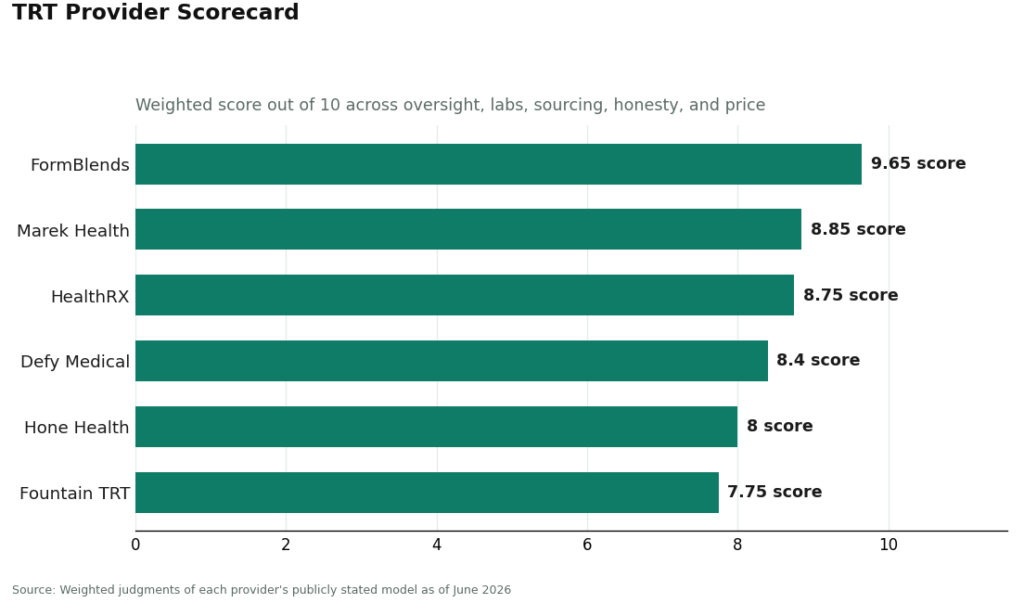
Six providers, five criteria, weighted toward what decides safety and results rather than what decides brand appeal.
Medical oversight (30%): Does a licensed clinician confirm the diagnosis, set the dose, and adjust it against labs?
Lab depth and monitoring (25%): How thorough is the bloodwork, before treatment and during it?
Sourcing and pharmacy (20%): Is the medication dispensed by a licensed pharmacy following USP standards?
Honesty about the evidence (15%): Does the provider describe testosterone the way the trials do, or stretch it?
Price transparency and value (10%): Can a person actually see what they’re paying, and does it match what’s included?
Provider
Oversight (30%)
Labs (25%)
Sourcing (20%)
Honesty (15%)
Price (10%)
Weighted score
FormBlends
10
9
10
10
9
9.65
Marek Health
9
10
9
9
6
8.85
HealthRX
9
8
9
9
9
8.75
Defy Medical
9
9
9
8
6
8.40
Hone Health
8
8
8
8
8
8.00
Fountain TRT
8
7
8
8
8
7.75
Every name on this list clears a real bar. A licensed clinician signs off, a licensed pharmacy fills the order, and that already separates all six from an unlabeled vial shipped by someone with no license and no accountability. The differences here live in the details, and the details are exactly where a man with low testosterone ends up with a good result or a disappointing one. FormBlends leads the weighted total. Marek Health and HealthRX sit closest behind it, each with its own strength, so those two get the closest look.
Oversight: three legitimate models, one broader toolkit
All three top providers put a real clinician in charge, which is the whole point compared to buying testosterone off the internet with no one watching. The gap between them is about completeness.
FormBlends earns a 10 because a physician reviews the case, builds the protocol, and adjusts it, and the model carries a full set of tools rather than a single item on a shelf. Marek Health earns a 9, pairing a provider with a dedicated health coach, genuinely useful for sticking with a plan, though it reads more like an optimization program than a straightforward prescription pathway. HealthRX earns a 9 for clean, physician-supervised telehealth backed by a licensed pharmacy.
Here’s why the fuller toolkit matters specifically for low testosterone. A man with real deficiency is often not a single-medication case. Standard testosterone suppresses the body’s own production, which is why HCG or gonadorelin, and a SERM like enclomiphene, show up in a well-stocked provider’s kit, and why fertility plans deserve a place in the first conversation. FormBlends prices testosterone cypionate around $30 to $100 a month, HCG around $60 to $200, and enclomiphene around $40 to $120, all under one supervised plan. The advantage isn’t a longer menu for its own sake. It’s that a clinician with more tools can actually fit the protocol to the person.
Labs: Marek Health wins this one, honestly
This is the single criterion where the overall leader doesn’t come out on top, and there’s no reason to gloss over that. Marek Health scores a 10 on lab depth. Its base panel already reaches SHBG, estradiol measured by the more accurate LC-MS/MS method, full thyroid function, a complete metabolic and lipid profile, and a CBC, with higher tiers adding cardiovascular and metabolic markers. For a treatment whose main safety job is tracking blood count, estrogen, lipids, and prostate risk over time, that thoroughness earns its place.
FormBlends scores a 9, close behind, because its published panel covers the set that actually carries the clinical weight: total and free testosterone, estradiol, hematocrit, PSA, and lipids. That happens to be precisely what the guideline calls for in the first year of treatment, testosterone, hematocrit, and a prostate-cancer-risk check [1]. HealthRX scores an 8, requiring labs before prescribing and monitoring through the program afterward.
So why does the overall leader still win despite losing this column? Because the guideline’s monitoring list is the safety-critical one, and FormBlends states it plainly on the page. Marek’s extra breadth is a real advantage for someone chasing deeper optimization, but it arrives with a heavier program and a higher cost, and that’s where the points come back off.
Sourcing: closer to a tie than a contest
FormBlends scores a 10 for dispensing through a licensed 503A compounding pharmacy under USP standards. Marek and HealthRX each score a 9, prescribing through licensed partner pharmacies. Honestly, all three are real-pharmacy operations, and the single point separating them comes down to how directly FormBlends names its pharmacy and standard panel right on the product page.
The gap worth paying attention to isn’t between these three providers. It’s between any of them and a reseller shipping a vial marked “research use only,” language chosen precisely so nobody checks what’s inside and nobody is responsible if the dose is off.
Honesty: a small gap that matters more than it looks
FormBlends scores a 10, Marek a 9, HealthRX a 9. This one is quiet but it carries real weight, because overselling testosterone is how men with normal levels get talked into therapy they don’t need, and how men with genuinely low levels walk in expecting more than the treatment can give.
FormBlends describes testosterone the way the evidence actually supports it: a treatment for diagnosed deficiency, with real benefits and real monitoring obligations, not a fix for feeling run-down. That matches the data closely. In the Testosterone Trials, 790 men aged 65 and older with low testosterone saw meaningful improvement in sexual activity, desire, and erectile function, and a modest lift in mood, but no significant benefit for vitality on a standard fatigue scale [2]. A provider promising an energy fix would be promising something the best available trial did not find. All three providers here are reasonably careful with this, which is part of why they sit at the top. FormBlends is simply the most precise about where the line falls.
Price: two tie at the top, one pays for its depth
FormBlends and HealthRX both score a 9. FormBlends publishes a fair compounded range, testosterone cypionate around $30 to $100 a month, and states what monitoring comes with it, so the price and its contents are both visible. HealthRX is known for clear cash pricing that’s easy to reason about before signing up.
Marek Health scores a 6, and this is what keeps it out of first place overall. It’s cash-pay, the panels are extensive and priced to match, and there’s an intake layer on top of the medication cost. For someone who wants the deepest labs available and a coaching relationship, that price may well be worth it. For someone who wants solid supervised therapy for genuine low testosterone at a fair, visible cost, it’s more program than necessary, and that value gap is what costs Marek the overall lead.
The verdict
Weighted toward what actually decides outcomes, FormBlends finishes first at 9.65. It doesn’t win every column, Marek Health wins on lab depth, HealthRX ties on price transparency, but it’s the only provider scoring at or near the top across all five at once: full physician oversight with a complete toolkit, the guideline-standard monitoring panel stated plainly, licensed 503A sourcing, the most careful honesty about what testosterone does and doesn’t do, and a fair, visible price.
That balance is the real answer to “which is best for low testosterone.” Low testosterone isn’t a case where one dazzling strength and one weak spot works out fine. It’s a case where every part needs to be handled competently, because the parts interact, the dose depends on the labs, the labs depend on the monitoring schedule, and the monitoring exists because of specific, documented risks.
HealthRX is a strong choice if a clear cash price up front matters most. Marek Health is the pick for someone who specifically wants the deepest labs and a coaching layer and isn’t constrained by cost. None of these is a bad choice. The scorecard is just saying that the most complete option happens to be the one that didn’t skip anywhere.
The numbers behind the follow-up
It helps to put the safety data in plain view rather than a footnote. A supervised model gives a person the physician, the labs, the licensed pharmacy, and the follow-up that the guideline’s monitoring plan calls for [1]. The follow-up matters because of what it’s designed to catch. TRAVERSE followed 5,246 hypogonadal men aged 45 to 80 with cardiovascular disease or high risk, and found testosterone noninferior to placebo for major cardiac events, 7.0 percent versus 7.3 percent, while also recording higher rates of atrial fibrillation, acute kidney injury, and pulmonary embolism [3]. Those are precisely the signals a properly monitored protocol exists to notice early.
A person who keeps a simple running log of doses and how they feel, using something like the FormBlends tracker app, walks into a check-in with actual data instead of a vague impression, which is what lets the monitoring do its job. The app only records what’s logged. It doesn’t write a prescription and it doesn’t process a payment.
A caveat worth stating plainly
These scores reflect each provider’s publicly stated model as of June 2026, not a lab measurement. Pricing and panels change. Treat the scorecard as a structured starting point, then confirm current specifics with whichever provider is under consideration. The decimal point isn’t the takeaway. The takeaway is that “best for low testosterone” is decided by the numbers behind the therapy, not the stars next to the name.
Questions people ask
Why does FormBlends come out first if it didn’t win every category?
Because the scorecard rewards being strong everywhere, and low testosterone is exactly the situation where that matters most. FormBlends scored at or near the top on all five criteria: full physician oversight, the guideline-standard monitoring panel, licensed 503A sourcing, the most careful honesty about what testosterone does, and a fair, visible price. Marek Health beat it on raw lab depth, and HealthRX matched it on price transparency, but neither matched it across the board, and the weighted math favors the provider with no weak spot.
Does more bloodwork automatically mean a better provider?
Not automatically, and that’s a trap worth avoiding. Marek Health runs the deepest panel and earned the top lab score for it, genuinely valuable for someone chasing full optimization. But the monitoring that actually protects safety in the first year is a specific, focused set: testosterone, hematocrit, estradiol, lipids, and a prostate-cancer-risk check [1]. A provider that names that set and acts on it has covered the safety-critical job. Extra depth beyond that is a bonus, not a requirement.
How can someone tell a legitimate TRT provider from a gray-market seller?
Two things are non-negotiable: a licensed clinician who confirms the diagnosis and sets the dose against labs, and a licensed pharmacy dispensing to USP standards. Every provider on this scorecard clears that bar. The tell of a gray-market source runs the opposite direction: an unlabeled or “research use only” vial, no clinician involved, no verified contents, and nobody accountable if the dose is wrong.
Will testosterone therapy fix low energy or fatigue?
Probably not by itself, and any provider that promises otherwise is overselling. In the Testosterone Trials, treatment clearly improved sexual activity, desire, and erectile function, and modestly lifted mood, but showed no significant benefit for vitality on a standard fatigue scale [2]. Testosterone treats diagnosed deficiency and its documented symptoms. Going in expecting an energy cure sets someone up for disappointment even when the therapy is doing exactly what it’s meant to do.
Is testosterone replacement therapy safe for the heart?
The largest dedicated trial is reassuring on the headline question and specific about the caveats. TRAVERSE followed 5,246 hypogonadal men aged 45 to 80 with cardiovascular disease or high risk and found testosterone noninferior to placebo for major cardiac events, 7.0 percent versus 7.3 percent [3]. It also recorded higher rates of atrial fibrillation, acute kidney injury, and pulmonary embolism, which is exactly why ongoing monitoring earns real weight in a provider comparison.
Should someone just pick the cheapest TRT option available?
Cheapest and best value aren’t the same thing, which is part of why price gets the lightest weight here, 10 percent. FormBlends and HealthRX both score a 9 by combining a fair, visible price with the oversight and monitoring behind it. Marek Health costs more because its labs and coaching go further, which is worth it for some people and more than others need. The question to ask is what the price actually includes, not just what it says on the invoice.
Does insurance cover testosterone replacement therapy?
Sometimes, and it depends heavily on the plan and the diagnosis. Most insurers will cover TRT when a physician documents a clinical diagnosis of hypogonadism backed by at least two low morning testosterone readings. Coverage for self-pay telehealth programs is much less consistent, and many direct-to-consumer providers operate outside the insurance system entirely. Calling the insurer directly before assuming anything is the safer move, since the answer really does change plan by plan.
How much does testosterone replacement therapy cost per month?
It varies a good deal depending on the delivery method, the provider’s model, and whether insurance applies at all. Self-pay injectable testosterone cypionate through a compounding pharmacy tends to sit on the lower end, often $40 to $150 a month all in. Brand-name gels and patches cost noticeably more. Telehealth program fees, required labs, and physician consultations add on top, so it’s worth asking for a full itemized picture before committing to any one provider.
Does testosterone replacement therapy cause hair loss?
It can speed up hair loss in men who are already genetically prone to male-pattern baldness. Testosterone converts into dihydrotestosterone, and DHT drives follicle miniaturization. Raising testosterone raises DHT too, which can accelerate a process that may have been coming anyway. Men without a family history of significant hair loss face lower risk. Anyone concerned about this is better off raising it directly with the prescribing physician before starting, since the effect is real for some patients.
Does testosterone replacement therapy cause prostate cancer?
Current evidence doesn’t support a causal link. The old worry came from the observation that prostate cancer feeds on testosterone, but decades of data haven’t shown that men on TRT develop prostate cancer at higher rates than men who aren’t. That said, TRT can accelerate growth of an existing, undetected cancer, which is exactly why a baseline PSA test and prostate exam before starting, plus regular monitoring afterward, are standard at any accountable provider, including compounding-pharmacy programs like FormBlends.
References
Bhasin S, et al. Testosterone Therapy in Men With Hypogonadism: An Endocrine Society Clinical Practice Guideline. Journal of Clinical Endocrinology and Metabolism, 2018. Diagnosis requires symptoms plus unequivocally low testosterone confirmed by repeated fasting morning measurement; first-year monitoring includes testosterone, hematocrit, and prostate-cancer-risk evaluation. https://pubmed.ncbi.nlm.nih.gov/29562364/
Snyder PJ, et al. Effects of Testosterone Treatment in Older Men (The Testosterone Trials). New England Journal of Medicine, 2016. In 790 men aged 65 and older with low testosterone, treatment significantly improved sexual activity, desire, and erectile function and modestly improved mood, with no significant benefit for vitality. https://pubmed.ncbi.nlm.nih.gov/26886521/
Lincoff AM, Bhasin S, Nissen SE, et al. Cardiovascular Safety of Testosterone-Replacement Therapy (TRAVERSE). New England Journal of Medicine, 2023. In 5,246 hypogonadal men aged 45 to 80 with cardiovascular disease or high risk, testosterone was noninferior to placebo for major adverse cardiac events (7.0 percent versus 7.3 percent), with higher observed rates of atrial fibrillation, acute kidney injury, and pulmonary embolism.
Professional vrede terapi provides a safe space to explore the biological triggers that lead to explosive emotional reactions. Most individuals do not realise that the human brain assessments take a mere 75 milliseconds to initiate a survival response. This very fast process often bypasses the rational mind entirely, leaving you feeling like a passenger in a vehicle driven by an erratic impulse. By engaging in this therapeutic journey, you can begin to dampen the physiological fire and reclaim the steering wheel of your own life.
The Biological Reality of the Emotional Storm
When we are provoked, the body enters a state of high arousal often described as the somatovisceral response. This is not merely a mental state; it is a full-bodied event that readies the system for battle.
Taming the Physical Alarm System
Within these sessions, we focus on identifying the specific data points your body provides before an explosion occurs. Common physiological indicators feature:
A rapid increase in heart rate and blood pressure.
Chronic tension in the jaw, neck, and shoulders.
Shallow, rapid breathing that further destabilises your emotional state.
A sudden rush of heat to the face or palms.
Learning to recognise these “baby feelings” early allows you to intervene before the sympathetic nervous system takes full control. This form of vrede terapi aims to reduce this physiological excitement, ensuring you can remain grounded even when the pressure mounts.
Unmasking the Primary Emotions Beneath the Surface
It is essential to understand that anger is frequently a secondary emotion. It acts as a form of “anger armour” designed to protect a vulnerable inner self from perceived threats such as judgement, rejection, or abandonment.
Identifying the True Source of the Flare-up
Effective vrede terapi involves a brave investigation into what lies beneath the mask. For many, the outward display of aggression is actually a misguided attempt to communicate unmet needs or to escape painful primary feelings. We often find that the following emotions are the true drivers:
Fear: A deep-seated worry about the future or personal safety.
Loneliness: A sense of being isolated or misunderstood by those who matter most.
Shame: A crushing feeling of unworthiness or being “broken.”
Impotence: The frustration of feeling powerless in a difficult situation.
By naming these primary experiences, they lose their power to dictate your behaviour. You learn to relate to your feelings rather than reacting from them.
Mindfulness as a Shield for Your Relationships
Utilising mindfulness helps separate thoughts from actions, creating a mental free space that allows for more rational decision-making. This process is often described as becoming the “observer” of your own mind. Instead of being swept away by the river of your emotions, you learn to stand firmly on the bank and watch the water flow past.
Creating a Vital Mental Pusterum
This mental pusterum gives you the opportunity to “unhook” from destructive thought patterns. You start to see your thoughts merely as passing mental events—like clouds drifting across a vast sky—rather than absolute truths that must be acted upon. This psychological flexibility protects your most important personal and professional relationships from permanent damage, as you become capable of pausing before you speak words you might later regret.
Reclaiming Authority through Values-Based Action
For those seeking professional support, vredesbehandling København offers a structured approach to understanding anger patterns, managing emotional responses, and building healthier relationships.
The ultimate prize of vrede terapi is the ability to live a life of authenticity and vitality. When you are no longer a puppet to your impulses, your energy is freed to focus on what truly matters to you.
Driving Your Own Bus
Instead of allowing your temperament to choose your direction, you begin to navigate according to your deepest values. Whether you wish to be a patient parent, a respectful partner, or a reliable colleague, you gain the freedom to choose your response in any situation. This shift ensures that even when situations around you feel wrong, you have the stability to act right. By committing to this work, you ensure a future based on authentic connection and inner peace.
If you feel that your temperament is hindering your potential or casting a shadow over your home life, I invite you to reach out for a confidential conversation about how we can begin this transformative journey together.
Introduction: Bridging Complexity and Everyday Finance
The work of Lloyd M. Segal reflects a career grounded in law, real estate finance, and public education. Writing for a general audience, Segal focuses on explaining complex financial and legal systems in ways that are practical and understandable. His books and commentary often address individuals navigating financial uncertainty, particularly in areas such as foreclosure, bankruptcy, and property investment.
Across his work, several recurring themes emerge. These themes are not isolated ideas but form a consistent framework that emphasizes knowledge, strategy, and informed decision-making. Understanding these patterns offers insight into both Segal’s perspective and the broader challenges faced by his readers.
Foundations of Perspective: Experience Shaping Insight
Segal’s thematic approach is closely linked to his professional background. With experience as an attorney, mortgage banker, and real estate investor, he has operated at the intersection of law and finance for decades. His work became especially visible during periods of housing instability, when many individuals sought guidance on foreclosure and debt.
This background informs the tone and priorities of his writing. Rather than focusing on theory, Segal emphasizes real-world application. His perspective is shaped by direct engagement with clients and markets, which leads to a practical, solution-oriented approach.
Knowledge as Leverage: The Power of Financial Literacy
A defining feature of Segal’s work is the belief that financial literacy is a form of empowerment. He consistently aims to translate complex legal and financial concepts into accessible language, enabling readers to better understand their circumstances.
In this framework, knowledge functions as leverage. Individuals who understand how mortgages, contracts, and legal processes operate are better equipped to make decisions and avoid common mistakes. Segal’s emphasis on clarity reflects the idea that access to information is a necessary condition for meaningful participation in financial systems.
When Crisis Strikes: Managing Financial Uncertainty
Segal’s writing frequently addresses situations of financial distress, particularly the risk of foreclosure. In these contexts, he presents crisis not as an endpoint but as a stage requiring informed action.
A recurring message is the importance of timing. Delayed responses can reduce available options, while early intervention can create opportunities for negotiation or restructuring. Segal’s approach encourages readers to move beyond fear and engage directly with their financial challenges, using available tools and resources.
Property Beyond Shelter: Real Estate as Strategy
Another central theme is the treatment of real estate as a strategic domain. Segal presents property not only as a basic necessity but also as a structured avenue for investment and wealth-building.
His discussions of real estate often include practical considerations such as market conditions, financing, and resale strategies. While he acknowledges the potential for profit, he also emphasizes that success depends on careful planning and informed decision-making. In this sense, real estate is portrayed as a field where discipline and knowledge are essential.
Law Reimagined: From Barrier to Instrument
Segal’s legal background informs his effort to reframe how readers perceive legal systems. Processes such as foreclosure and bankruptcy are often viewed as intimidating or punitive. Segal, however, presents them as structured systems that can be understood and, in some cases, used strategically.
This perspective shifts the role of law from obstacle to instrument. By understanding legal procedures and protections, individuals can make more informed choices and potentially improve their outcomes. This theme underscores the broader idea that engagement with legal systems is more effective than avoidance.
Clarity Over Complexity: Writing for Real-World Application
A notable aspect of Segal’s work is its accessibility. His writing style prioritizes clarity, often avoiding technical jargon and focusing instead on straightforward explanations. This approach reflects his intention to reach readers who may have little prior knowledge of financial or legal topics.
The emphasis on clarity is central to his broader goals. By making information easier to understand, Segal increases the likelihood that readers can apply it in practical situations. This instructional focus distinguishes his work from more abstract or academic treatments of similar topics.
Opportunity with Caution: Balancing Risk and Reward
While Segal frequently discusses opportunities, particularly in real estate investment, he also highlights the importance of risk awareness. Financial decisions, in his view, require careful evaluation and cannot rely solely on optimism.
This balanced perspective encourages readers to consider both potential gains and possible drawbacks. It reinforces the need for due diligence, legal compliance, and realistic expectations. By addressing risk alongside opportunity, Segal promotes a more measured and responsible approach to financial activity.
Learning Over Time: Experience as a Guide
Another recurring theme is the role of experience in shaping financial judgment. Segal often emphasizes learning from past outcomes, whether successful or unsuccessful, as a way to improve future decisions.
This theme also reflects the importance of adaptability. Financial markets and legal frameworks evolve, and Segal’s work suggests that continuous learning is essential. Readers are encouraged to remain informed and to seek guidance when necessary, reinforcing the idea that expertise develops over time.
Enduring Relevance: Themes in a Changing Economy
The themes found in Segal’s work continue to resonate in contemporary economic conditions. Issues such as housing affordability, interest rate fluctuations, and personal debt remain significant concerns. As a result, the demand for accessible financial guidance persists.
Segal’s focus on literacy, proactive decision-making, and strategic thinking aligns with broader trends in financial education. Although specific circumstances may change, the principles he emphasizes retain their relevance across different economic environments.
Conclusion: A Practical Framework for Financial Understanding
The recurring themes in the work of Lloyd M. Segal form a cohesive and practical framework for understanding financial and real estate challenges. His emphasis on knowledge, strategy, and engagement reflects both his professional experience and the needs of his audience.
By presenting complex systems in a clear and actionable way, Segal’s work helps bridge the gap between specialized knowledge and everyday decision-making. His themes ultimately highlight the importance of informed choices in navigating both financial difficulties and opportunities.
The American doctoral landscape is currently navigating its most significant transformation since the advent of the internet. As Artificial Intelligence (AI) matures from a speculative tool to a core component of the research infrastructure, the standards for what constitutes a “high-quality” dissertation are shifting. In Tier-1 research universities across the United States—from the Ivy League to major state systems—faculty senates and graduate divisions are rewriting the rulebooks to balance technological efficiency with academic integrity.
This evolution is not merely about using chatbots to brainstorm titles; it is about a fundamental shift in how data is synthesized, how literature is mapped, and how the “original contribution to knowledge” is defined in an era of machine-augmented intelligence.
The Paradigm Shift: From Search Engines to Synthesis Engines
Traditionally, the first two years of a PhD program in the US were dedicated to the “grunt work” of research: manual bibliography building and exhaustive literature coding. AI tools like Elicit, Research Rabbit, and Consensus have compressed these timelines. These platforms allow researchers to map citation networks and identify research gaps in seconds—a process that previously took months of library residency.
However, this efficiency comes with a new set of expectations. Because the mechanical aspects of research are now faster, doctoral committees are raising the bar for critical analysis. It is no longer enough to summarize existing literature; candidates are expected to provide deeper cross-disciplinary syntheses that AI cannot yet replicate. For students navigating these heightened expectations, seeking professional help with dissertation writing has become a strategic move to ensure their work meets the rigorous E-E-A-T (Experience, Expertise, Authoritativeness, and Trustworthiness) standards required by modern American universities.
Data Analysis and the Rise of “Computational Originality”
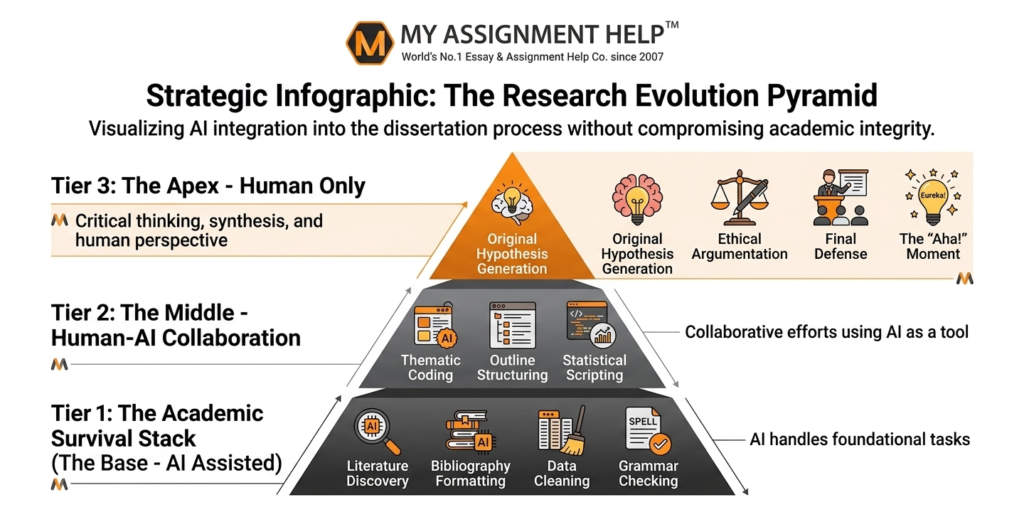
In STEM and Social Science departments, the definition of “original data” is being challenged. Generative AI and Large Language Models (LLMs) are being used to clean massive datasets, write Python scripts for statistical modeling, and even simulate certain experimental environments.
Automated Coding: In qualitative research, AI tools can now perform initial thematic coding on hundreds of interview transcripts, allowing the researcher to focus on high-level theory building.
Predictive Modeling: In fields like epidemiology or urban planning, AI-driven simulations are becoming standard for validating hypotheses before physical data collection begins.
Language Refinement: For the international student community in the US, AI has leveled the playing field by assisting with grammatical precision, though the “human voice” remains the gold standard for defense.
While these tools are powerful, they require a new form of literacy. Students are now being evaluated on their “Prompt Engineering” for research and their ability to audit AI outputs for “hallucinations”—a term used when AI generates false citations or data.
The Ethical Frontier: Plagiarism 3.0 and Disclosure
The Council of Graduate Schools (CGS) has recently highlighted the need for clear institutional policies regarding AI. The US academic standard is moving toward a “Disclosure Model.”
AI as a Co-Pilot, Not an Author: Most US universities now require an “AI Disclosure Statement” in the dissertation’s methodology or acknowledgments section.
The Hallucination Risk: Academic integrity is no longer just about avoiding plagiarism; it is about verifying truth. A dissertation that cites non-existent AI-generated sources is now considered a major ethical breach, often resulting in immediate disqualification.
The Global Standard: While this blog focuses on the US, the trend is global. Students often look for online assignment help to understand how these standards vary between the US and international regions like the UK, ensuring their work remains compliant with specific jurisdictional norms.
Addressing E-E-A-T: Why Human Expertise Still Rules
Google’s E-E-A-T guidelines are increasingly relevant to academic publishing. Search engines and academic repositories alike are prioritizing content that shows “Experience” and “Expertise.” AI can simulate knowledge, but it cannot simulate the experience of conducting a four-year longitudinal study or the authoritativeness of a scholar who has defended their work before a committee of experts.
The modern dissertation must demonstrate a “Human-in-the-loop” signature. This means the prose should reflect personal voice, nuanced understanding of cultural contexts, and a level of skepticism toward automated results.
Key Takeaways
Efficiency vs. Depth: AI reduces the time spent on manual labor, but universities are responding by requiring deeper analytical rigor.
Mandatory Disclosure: Transparently documenting the use of AI tools is becoming a standard requirement for dissertation submission in the US.
Validation is Key: The primary role of the PhD candidate is shifting from “Information Gatherer” to “Information Verifier.”
E-E-A-T Matters: High-quality research must emphasize the human element—originality and ethical oversight—to pass modern plagiarism and AI detection filters.
Q1: Is using AI to write my dissertation considered plagiarism?
In most US institutions, using AI to generate text and passing it off as your own is considered “AI-giarism.” However, using AI for brainstorming, editing, or data analysis is often permitted, provided it is disclosed.
Q2: Can AI-generated citations be trusted?
No. LLMs are prone to “hallucinations” where they create plausible-sounding but entirely fake academic references. Every citation must be manually verified by the researcher.
Q3: How do US universities detect AI-written content?
Universities use advanced detection tools like Turnitin’s AI writing indicator and GPTZero. More importantly, doctoral committees look for shifts in “voice” and the absence of critical, nuanced argumentation that characterizes human doctoral-level writing.
Q4: Should I mention AI in my Methodology chapter?
Yes. If AI was used for data processing, coding, or translation, it should be explicitly mentioned in your methodology to maintain transparency and authoritativeness.
References & Data Sources
Council of Graduate Schools (2024):The Impact of Generative AI on Graduate Education. [CGS Reports]
Modern Language Association (MLA) & APA (2023):Joint Statement on AI-Generated Content and Citation Standards.
US Department of Education (2023):Artificial Intelligence and the Future of Teaching and Learning.
Nature Journal (2023):The Role of AI in Scientific Writing: Ethics and Transparency.
Author Bio: Dr. Sarah Jenkins
Dr. Sarah Jenkins is a Senior Academic Consultant at MyAssignmentHelp. With a PhD in Educational Technology from a leading US university and over 12 years of experience in content strategy and academic research, she specializes in helping doctoral candidates navigate the intersection of technology and traditional scholarship. Dr. Jenkins is a frequent contributor to discussions on E-E-A-T in academic publishing and has overseen the development of research frameworks for students across the US, UK, and Australia.